Meriel Jeater, curator in the Department of Archaeological Collections and Archive at the Museum of London, explains that ‘mudlarking as a profession started in the late 18th and then into the 19th century, and was the name given to people literally scavenging for things on the riverbank and selling them.’ These original mudlarks were often children, mostly boys, who would earn a few pennies selling things like coal, nails, rope and bones that they found in the mud at low tide. ‘Anywhere there was river traffic, you’d find mudlarkers lurking to pilfer as the Thames was obviously a major trade route,’ says Jeater. In the book, London, Labour & The London Poor, published in 1851, author Henry Mayhew interviewed a 13-year-old mudlark. Jeater adds: ‘He describes them as pretty much the poorest level of society, scrabbling around on the foreshore trying desperately to make a living.’ A mudlark’s income was very meagre, and they were renowned for their tattered clothes and terrible stench. A mudlark was a recognised occupation until the early 20th century.
Today’s mudlark is different from those poor wretches of
the 1800’s. Instead of mudlarking to survive,
mudlarks today have a passionate interest in London’s
rich archaeology and history. Since 1976, the 51
members of the Society of Thames Mudlarks have
changed history many, many times. They work very closely
with the Museum of London and the Portable
Antiquities Scheme (PAS) where their finds are
recorded.
Historic Importance of Mudlark Finds
Dr Michael Lewis, the Deputy Head of Portable
Antiquities and Treasure at the British Museum, says
that mudlarks’ finds can ‘alter our picture of the
past. Many of the finds are very small pieces. They
are like little pieces in a jigsaw puzzle that help us
create a picture of the past,’ he explains. ‘By
putting them together we get an idea of what’s going
on. They can actually rewrite history.’
Geoff Egan, former Finds Specialist at the British Museum, has written numerous books such as Dress Accessories and Toys, Trifles and Trinkets (with Hazel Forsyth) based on his research of mudlarks’ finds from the River Thames. He states that, ‘some of the most outstanding individual items, as well as entire categories of objects (e.g. shield-shaped strap-ends), could not have been written about without the fruitful cooperation between the mudlarks and Museum of London Archaeology Service.'
The mudlarks have found numerous toys (i.e. miniature plates and urns, knights on horseback and toy soldiers) that have actually changed the way historians view the Medieval period. ‘Made mainly from pewter, these medieval toys are exceptionally rare and have helped transform perceptions of childhood during the Middle Ages,’ says Hazel Forsyth, curator of post-medieval collections at the Museum of London. ‘These acquisitions are terribly important to the museum. Over 90% of our medieval metals collection comes from mudlarkers, and we have developed a special relationship with the Society of Thames Mudlarks over the years, logging finds and in many cases accepting artifacts into the collections.’ Over the last 30 years, the Museum of London has acquired over 90,000 objects recovered from the River Thames foreshore which is the longest archaeological site in Britain, but only a few of these artifacts are on display.
Roy Stephenson, manager of the archaeological archives at the Museum of London, states that ‘mudlark discoveries help fill gaps in the museum’s collection. That’s because, on land, metal objects were often melted down and reused. But if something fell in the river, it essentially vanished.’ The quality of the artifacts from the Thames is outstanding because of the anaerobic mud (no oxygen). The artifacts often come out of the mud in the same condition that they went in. Through these finds, the mudlarks increase the knowledge of the capital’s history. Stephenson states, ‘We are getting to see some absolutely fascinating things that come off the foreshore.’
WHO ARE THE MUDLARKS?
19th century mudlarks searching the River Thames
foreshore for coal, nails, rope, bones and anything
The visionaries behind the Thames Museum project, Steve Brooker and Nick Stevens, have their own vast collections of artifacts recovered from the River Thames over 25 years which will be displayed in the Thames Museum. The museum will also exhibit the finds recovered over the last 50 years from fellow mudlarks and mudlarkers. In a recent interview, Steve Brooker was asked why he goes mudlarking. He responded by saying that he wants ‘to change how we view history.’ Sharing his vision for the Thames Museum, he explains, ‘It’s about educating people about the past and what’s out there and getting them involved. It’s archaeology for everyone.’ The Thames Museum will tell the unique and epic stories behind the amazing artifacts found in the River Thames.
Steve Brooker


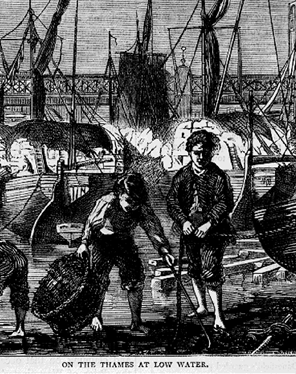
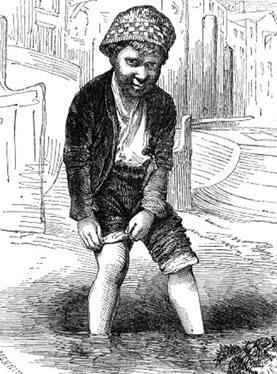
which can be sold
London Labour & London Poor, 1861